AI · June 23, 2026
Health, Biotech, and Longevity: The App Store for Drug Discovery Is Coming
Health, Biotech, and Longevity: The App Store for Drug Discovery Is Coming For years, the pharmaceutical industry was built around a familiar model: discover a molecule, patent it, test it, manufacture it, market it,…
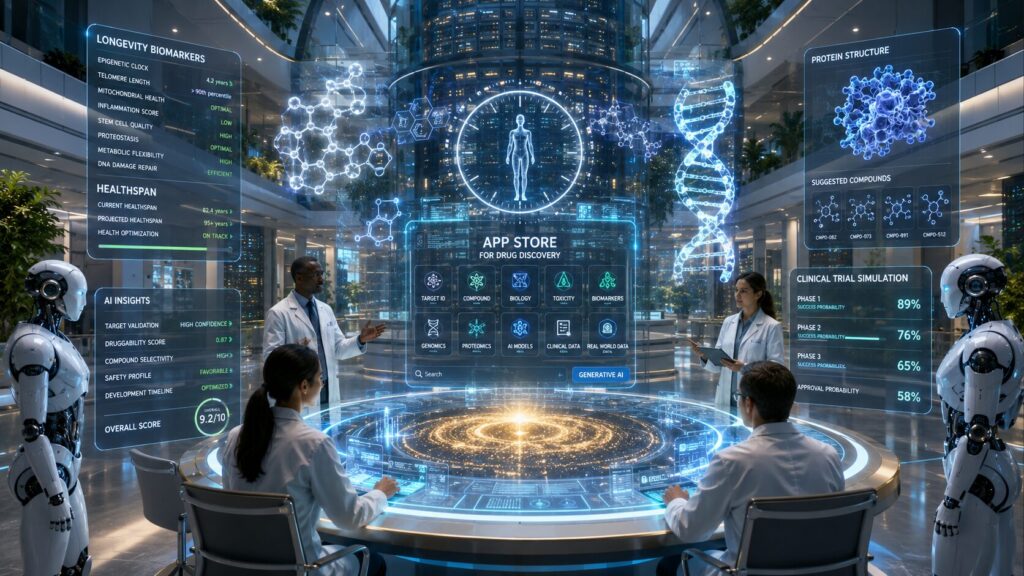
Health, Biotech, and Longevity: The App Store for Drug Discovery Is Coming
For years, the pharmaceutical industry was built around a familiar model: discover a molecule, patent it, test it, manufacture it, market it, and defend the moat for as long as possible. That model created some of the most valuable companies in the world, but it also carried enormous friction. Drug discovery was slow, expensive, failure-prone, and deeply dependent on institutional scale. The biggest pharmaceutical companies had the best data, the most scientists, the deepest pipelines, and the longest tolerance for failure.
Now that model is starting to change.
Eli Lilly’s recent AI push may be one of the clearest signals yet that big pharma is evolving from a drug company into a platform company. Lilly is not merely using artificial intelligence as a side tool for research. It is building the infrastructure, data systems, AI models, partner network, and computing capacity that could make it a central operating layer for the next generation of biotech startups.
That is the real story.
The headline is not simply “Lilly is using AI.”
Everyone is using AI.
The real headline is that Lilly appears to be turning its GLP-1 windfall into a biotech platform strategy. The profits from obesity and metabolic medicine are being recycled into the infrastructure of future drug discovery. Instead of only asking, “What drugs can Lilly discover for itself?” the company is asking a much bigger question: “What if Lilly could become the place where other biotech companies come to discover drugs faster?”
That is why the phrase “The App Store for Drug Discovery” is such a powerful article angle.
The original App Store did not merely sell software. It changed who could build software, how software reached users, how developers monetized their work, and how an entire ecosystem formed around a dominant platform. Apple owned the infrastructure, the marketplace, the rules, the distribution channel, and the trust layer. Developers brought creativity, specialization, and applications. The result was an explosion of mobile innovation.
Lilly’s AI biotech strategy points toward a similar possibility in life sciences. Imagine a world where early-stage biotech companies can access powerful AI models trained on decades of pharmaceutical research data. Imagine a small team working on cancer, fibrosis, autoimmune disease, obesity, neurodegeneration, or aging biology plugging into models that would have once been available only inside the walls of a trillion-dollar pharmaceutical company. Imagine that every experiment, every failed molecule, every useful assay, and every partner contribution makes the system smarter over time.
That is not just drug discovery.
That is networked drug discovery.
And it could reshape biotech the way cloud computing reshaped software startups.
“The future of pharma may not be one company discovering every drug; it may be one platform helping thousands of scientists discover better drugs faster.”
From Big Pharma to Platform Pharma
Traditional big pharma has always had platform characteristics. The major companies control labs, clinical trial infrastructure, regulatory expertise, manufacturing networks, sales channels, and global distribution. But historically, those assets were mostly used internally or through controlled partnerships. The company was the factory. The outside world was the acquisition funnel.
AI changes that.
Once drug discovery becomes increasingly computational, the most valuable asset may not be a single lab or single pipeline. It may be the learning system itself. The company that has the best data, best models, best compute, best partner network, and best feedback loops could become the platform through which hundreds of smaller biotech companies build.
That is the major shift.
In the old model, a biotech startup might spend years raising money, building a small team, buying software, licensing data, running experiments, and trying to prove a target. If successful, it might partner with big pharma or get acquired. In the new model, the startup may begin inside a platform environment where AI models, data infrastructure, molecule design tools, and development workflows are already available.
The value moves from isolated discovery to shared infrastructure.
This is why Lilly’s TuneLab and Nvidia-supported AI infrastructure matter. They suggest a future where pharmaceutical companies are no longer only competing molecule by molecule. They are competing platform by platform. The winners will not simply be the companies with the best drugs today. They may be the companies with the best engines for creating tomorrow’s drugs.
The GLP-1 Cash Machine Becomes an AI Engine
The timing is important. Lilly’s rise has been powered by the enormous demand for GLP-1 and incretin-based metabolic drugs. Obesity, diabetes, cardiovascular risk, and metabolic dysfunction are among the largest medical markets in the world. These drugs have changed investor expectations, public health conversations, and the competitive landscape of pharma.
But every blockbuster creates a strategic dilemma.
What do you do with the money?
A weaker company protects the current cash cow. A stronger company uses the cash cow to build the next machine.
Lilly appears to be doing the latter. Instead of treating GLP-1 profits as the endgame, the company is using them to fund the next platform: AI-enabled drug discovery, computational biology, automated labs, model training, and biotech partnerships.
This is how category leaders stay category leaders. They turn one wave of dominance into the infrastructure for the next wave.
The risk, of course, is that AI drug discovery is still early. The industry has seen plenty of hype. Many AI-first biotech companies have promised faster, cheaper, more precise drug development. Some have made progress, but the ultimate proof in medicine is not a demo, a molecule render, or a beautiful model output. The proof is clinical success. Does the drug work in humans? Is it safe? Can it beat the standard of care? Can it survive regulation, reimbursement, manufacturing, and real-world use?
That uncertainty is exactly why platform strategy matters.
No single AI model will magically solve drug discovery. But a platform that connects many companies, many datasets, many experiments, many therapeutic areas, and many feedback loops has a better chance of compounding. The intelligence improves as participation grows. The more biotechs use the system, the more diverse the learning becomes. The more diverse the learning becomes, the more valuable the system becomes.
That is the App Store logic.
Developers made the iPhone more valuable. The iPhone made developers more valuable. The ecosystem became the moat.
In biotech, the same logic could emerge: partners make the AI models better, the AI models make partners more productive, and the entire discovery network becomes more powerful over time.
The New Biotech Stack
The modern biotech stack is beginning to look very different from the old biotech stack.
The old stack was built around lab space, wet-lab talent, capital, patents, animal models, clinical trial design, and regulatory navigation. Those pieces still matter. In medicine, biology always gets the final vote. But the new stack adds layers that are becoming just as important: proprietary datasets, foundation models for biology and chemistry, generative molecule design, robotic experimentation, cloud-based collaboration, digital twins, multimodal patient data, predictive toxicology, and AI-assisted clinical development.
The new biotech company may be smaller, faster, more computational, and more dependent on platform access. It may not need to own every part of the discovery pipeline. It may plug into infrastructure the way a software startup plugs into AWS, Stripe, GitHub, and OpenAI.
That creates a massive opportunity.
The next generation of biotech entrepreneurs may not need to build everything from scratch. They may build on top of AI discovery platforms. They may specialize in a disease area, a target class, a biological mechanism, a patient population, or a unique dataset. The platform provides the horsepower. The startup provides the thesis.
This is where big pharma becomes something closer to a biotech operating system.
A true drug discovery platform would include data access, model access, workflow tools, experimental support, partner analytics, quality control, compliance, security, IP frameworks, and eventually marketplace dynamics. The most successful platform would not simply serve internal scientists. It would attract an ecosystem.
That is the real trillion-dollar possibility.
Longevity Moves From Wellness to Serious Biotech
At the same time, longevity is undergoing its own transformation.
For years, longevity was often treated as a wellness category: supplements, lifestyle optimization, biohacking, cold plunges, sleep trackers, fasting protocols, and influencer-driven routines. Some of that world is useful. Some of it is noisy. But the deeper shift now is that longevity is moving into serious biotech.
The field is increasingly focused on geroscience: the study of the biological mechanisms of aging and how those mechanisms drive age-related disease. Instead of treating cancer, Alzheimer’s, cardiovascular disease, frailty, immune decline, and metabolic dysfunction as completely separate problems, geroscience asks whether there are shared aging pathways underneath them.
That is a profound shift.
If aging biology can be measured, modified, and clinically targeted, then medicine could move from reactive disease treatment to proactive healthspan extension. The goal would not simply be living longer. The goal would be living healthier for longer, delaying the onset of chronic disease, preserving function, and compressing the period of decline near the end of life.
This is why ARDD 2026 matters. The Aging Research and Drug Discovery meeting is positioning the field around drug discovery, geroscience, clinical development, AI, biomarkers, and healthy longevity. That signals a maturing sector. Longevity is no longer only a consumer trend. It is becoming a serious scientific, pharmaceutical, and clinical category.
The most important watch areas are biomarkers, aging clocks, and AI target discovery.
Biomarkers: The Measurement Layer of Longevity
Longevity cannot become real medicine without measurement.
You cannot manage what you cannot measure. You cannot run credible clinical trials without endpoints. You cannot prove that an intervention modifies aging biology unless you can quantify biological age, disease risk, organ function, immune decline, inflammation, metabolic resilience, or cellular damage.
That is why biomarkers are so important.
A biomarker is a measurable signal of biological state. In longevity, biomarkers could include epigenetic patterns, proteomic signatures, metabolomic profiles, inflammatory markers, immune system features, imaging-based measurements, organ-specific biological age estimates, and functional performance indicators.
Aging clocks are one of the most exciting parts of this field. These tools attempt to estimate biological age or aging rate based on molecular or physiological data. Early clocks were often based on DNA methylation patterns. Newer clocks are becoming more diverse, using proteins, metabolites, imaging, single-cell data, and multi-omics integration.
But the field still has to answer hard questions.
Does a clock merely predict age, or does it reveal a causal mechanism of aging? If an intervention makes the clock look younger, does that mean the person is actually healthier? Can aging clocks predict disease risk better than existing clinical tools? Can they serve as surrogate endpoints for trials? Which clocks matter for which organs, which diseases, and which patient populations?
These questions will define the next stage of longevity biotech.
The winners will be the companies that turn biological age from a marketing claim into a clinically meaningful measurement system.
AI Target Discovery: Finding the Biology Beneath Aging
AI may be especially powerful in longevity because aging is not one pathway. It is a complex, networked biological process involving DNA damage, cellular senescence, mitochondrial dysfunction, inflammation, protein misfolding, stem cell exhaustion, epigenetic drift, immune remodeling, metabolic changes, and tissue-level decline.
No human researcher can manually integrate all of that complexity at full scale.
AI can help search biological networks, identify patterns across datasets, prioritize targets, predict molecule behavior, simulate interventions, and connect mechanisms that would be difficult to see through traditional analysis. This does not mean AI replaces scientists. It means AI becomes a scientific amplifier.
In longevity, AI target discovery could identify drugs that affect multiple aging pathways at once. It could help repurpose existing compounds. It could detect hidden relationships between age-related diseases. It could reveal why some people remain biologically younger than others. It could help design interventions that preserve resilience rather than simply treat disease after damage appears.
This is where longevity and AI drug discovery converge.
Lilly’s platform strategy is not explicitly a longevity company strategy, but the same infrastructure could matter deeply for aging-related diseases. Metabolic disease, neurodegeneration, cardiovascular disease, kidney disease, cancer, immune dysfunction, and frailty are all connected to aging biology. The more pharma companies build AI systems that understand disease mechanisms across massive datasets, the more likely they are to discover interventions that touch the biology of aging itself.
The Business Opportunity: The App Store for Drug Discovery
“The App Store for Drug Discovery” is powerful because it captures both the business model and the technological shift.
In this model, big pharma provides the platform. Biotech startups provide specialized innovation. AI models provide acceleration. Data provides compounding value. Patients eventually benefit from faster, smarter, more targeted development.
The platform could make money in several ways: partnerships, licensing, milestone economics, royalties, acquisitions, software access, data collaboration agreements, and preferred rights to promising discoveries. But the deeper value is strategic. The platform owner sees more science, more startups, more targets, and more molecules than any single internal R&D department could produce alone.
That creates information advantage.
If 100 biotech companies are building on a platform, the platform owner has a unique view of where innovation is happening. It can see emerging disease areas, model performance, target quality, data gaps, and promising molecules earlier than the rest of the market. That is not just a revenue opportunity. It is an intelligence network.
In the future, the most powerful pharma companies may not be the ones with the largest internal pipelines. They may be the ones with the best discovery ecosystems.
The Risks: Data, Trust, IP, and Clinical Reality
The opportunity is enormous, but it is not risk-free.
The first risk is data quality. AI models are only as good as the data used to train and validate them. Biomedical data is messy, fragmented, biased, incomplete, and often difficult to standardize. If the platform learns from weak data, it may produce weak predictions.
The second risk is intellectual property. Biotech companies will want to know who owns what. If their data improves a shared model, do they receive value? If the model helps generate a molecule, who controls the rights? If multiple partners contribute to similar discoveries, how are conflicts handled?
The third risk is trust. Smaller biotechs may love access to powerful tools, but they may also fear giving too much strategic visibility to a giant pharma company. A true platform must balance collaboration with neutrality. It must create enough trust for participants to contribute without feeling exploited.
The fourth risk is clinical translation. AI can accelerate hypothesis generation, molecule design, and experiment planning, but the body remains the final test. Biology is full of surprises. A model can be elegant and still fail in humans.
The fifth risk is hype. AI drug discovery will likely produce real breakthroughs, but not evenly, not instantly, and not without failure. Investors, founders, and media need to separate useful acceleration from magical thinking.
Still, the direction is clear.
The pharmaceutical industry is becoming more computational, more networked, more data-driven, and more platform-oriented.
Why This Matters for Healthspan
The biggest prize is not simply more drugs.
The biggest prize is a new model of medicine.
If AI platforms can shorten the path from biological insight to therapeutic candidate, and if longevity biomarkers can measure whether interventions improve human healthspan, then healthcare could gradually move upstream. Instead of waiting for disease to appear, medicine could identify biological decline earlier and intervene with more precision.
That would change the economics of healthcare.
The current system is built around treating sickness. The longevity biotech vision is built around preserving function. The current system often reacts after damage accumulates. The future system may monitor aging biology, predict risk, and intervene earlier.
This is why health, biotech, and longevity belong together.
GLP-1 drugs showed that metabolic intervention can reshape public health and create enormous markets. AI drug discovery platforms could reshape how therapies are built. Longevity science could reshape what medicine is trying to optimize.
Together, they point toward a future where the most valuable healthcare companies are not just drug sellers. They are discovery platforms, data networks, biological intelligence systems, and healthspan infrastructure companies.
The Big Takeaway
Lilly’s AI strategy may become a defining case study in the next era of pharma. The company is using today’s blockbuster profits to build tomorrow’s discovery engine. That engine may give smaller biotechs access to tools once reserved for the largest institutions. It may create a compounding data network. It may turn big pharma into platform pharma.
At the same time, longevity is crossing a threshold. The field is moving from consumer wellness into drug discovery, geroscience, biomarkers, aging clocks, clinical development, and AI target discovery. The question is no longer whether people are interested in living longer. The question is whether science can measure, validate, and safely modify the biology of aging.
The next great healthcare platform may not look like a hospital, a pill bottle, or a wellness app.
It may look like an AI-powered discovery marketplace where biotech companies, pharma giants, clinicians, researchers, and data systems collaborate to build the future of medicine.
The App Store for Drug Discovery is coming.
And longevity may become one of its most important categories.